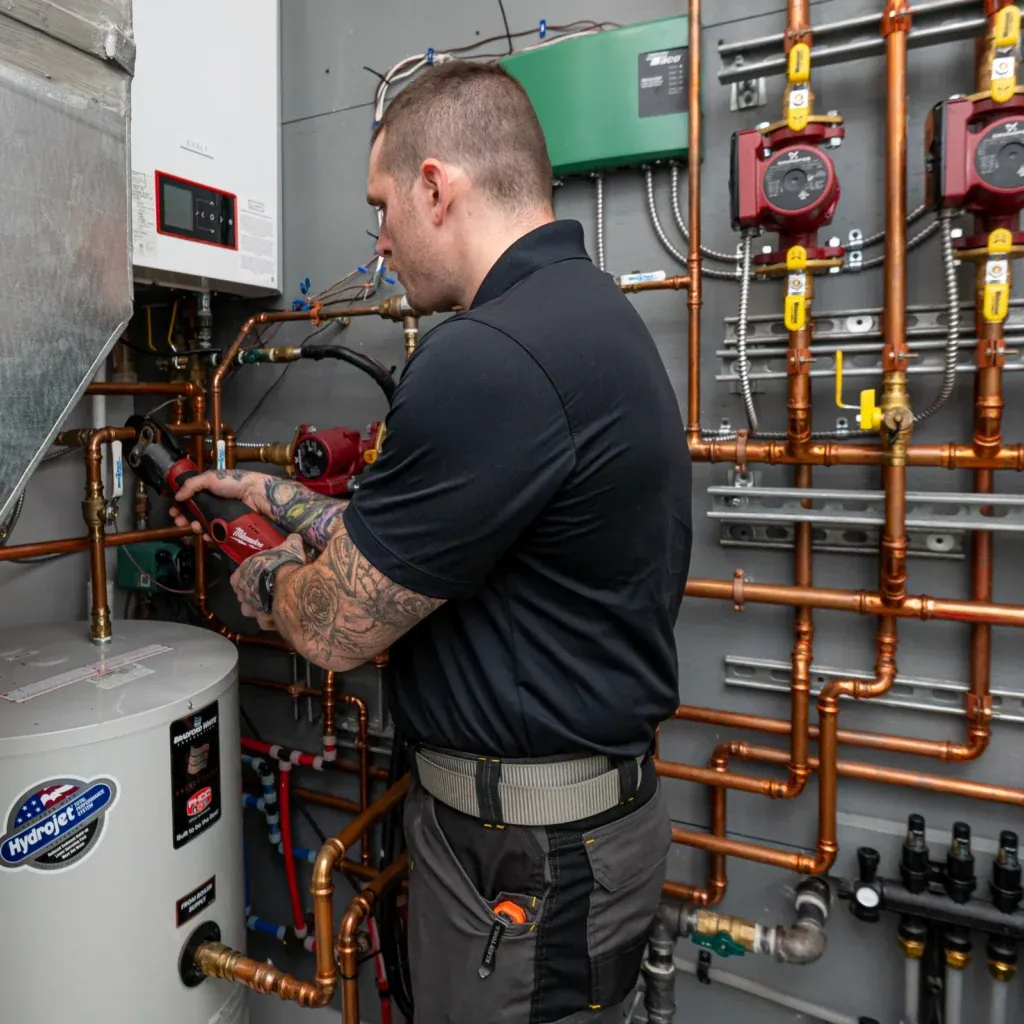
If your furnace or boiler is getting up there in years, you are probably caught between two questions: do I keep fixing it, or do I finally replace it? And if you replace it, how much more efficient does a new system really need to be to be worth the money? This guide walks through both, in plain language, the way we would explain it standing in your basement.
A quick note on scope. Empire State Plumbing installs and replaces high-efficiency gas furnaces and boilers, handles oil-to-gas conversions, and installs high-efficiency oil and propane systems for homes that have no gas main to convert to. Some homeowners also ask about electric heat pumps; those exist and have a place, but they are not what we focus on, and not something we install. Everything below is about getting the most out of a modern, properly sized combustion system — the kind of equipment that heats most homes across Albany, Rensselaer, Saratoga, and Schenectady counties.
When an old furnace or boiler is worth replacing
Age alone does not condemn a heating system, but it is the first thing we look at. A well-maintained gas furnace typically runs 15 to 20 years; a cast-iron boiler can run longer but still loses efficiency as it ages. Here are the signals that usually tip a repair toward a replacement:
- The system is 15+ years old and the repair is expensive. A good rule of thumb: if the repair costs more than a third of a new system and the unit is past 15 years, replacement is often the smarter dollar.
- You are calling for repairs every season. Two or three breakdowns in two or three winters is a system telling you it is near the end.
- Heating bills keep climbing for no clear reason. An aging unit drifts down in efficiency, so you pay more each year to stay just as comfortable.
- Rooms heat unevenly, or the system short-cycles. Often a sign the equipment is undersized, oversized, or no longer holding its rated output.
- The heat exchanger or boiler block is cracked. This is a safety issue, not a comfort one, and it almost always means replacement.
None of these are automatic. A 12-year-old furnace with a single failed igniter is a repair, full stop. The honest answer depends on the specific unit in front of us — which is why we will always tell you when a fix is the better call.
What AFUE efficiency ratings actually mean
Every gas, oil, and propane furnace and boiler carries an AFUE rating — Annual Fuel Utilization Efficiency. It is simply the percentage of fuel that becomes usable heat in your home over a full season. An 80% AFUE furnace turns 80 cents of every fuel dollar into heat and sends the other 20 cents up the flue. A 96% AFUE furnace keeps 96 cents working for you.
Here is why this matters more than it sounds. Many older systems still running today were 70% to 80% efficient when new, and they have drifted lower with age. Stepping up to a modern high-efficiency condensing unit in the 90% to 98% AFUE range means a meaningful share of fuel you are currently losing stays in the house instead. The exact savings depend on your fuel prices, your home, and how cold the winter runs — we will not pretend to know your bill to the dollar — but the efficiency gap is real and it compounds every heating season.
Two practical points:
- Higher AFUE costs more up front. A 95%+ condensing unit is a bigger investment than an 80% unit. The math usually favors high-efficiency in our climate, where the heating season is long, but it is worth running honestly for your situation.
- High-efficiency units vent differently. A condensing furnace or boiler exhausts through PVC sidewall venting rather than the old chimney, and it produces condensate that needs a drain. In an older Capital Region home, planning that venting and drainage up front is part of doing the job right.
Gas furnace vs. boiler: which system do you have?
The right replacement starts with what is already in your home, because furnaces and boilers heat in fundamentally different ways.
A furnace heats air. It burns fuel, warms air, and a blower pushes that air through ducts to vents in each room. If you have supply registers in the floors, walls, or ceilings, you have forced-air heat and almost certainly a furnace. Furnaces pair naturally with central air conditioning because they share the same ductwork.
A boiler heats water. It warms water (or makes steam) and circulates it to radiators, baseboard, or in-floor tubing, which radiate heat into each room. If you have cast-iron radiators or baseboard along the walls and no air vents, you have a boiler. Many older homes across Troy, Albany, and the river towns were built around boilers and radiators.
As a rule, we replace like with like — a furnace with a furnace, a boiler with a boiler — because switching systems means tearing out and rebuilding either ductwork or piping, which is rarely worth it. The bigger upgrade is going from an old, low-efficiency unit to a modern high-efficiency one of the same type, properly sized and properly vented.
Oil-to-gas conversion: when it pays off
If you currently heat with oil, you have probably wondered about switching to natural gas. In much of the Capital Region this is a genuinely good option — when a National Grid gas main already runs down your street. That is the deciding factor.
An oil-to-gas conversion typically involves removing or abandoning the old oil equipment and tank, running a new gas line from the street, and installing a high-efficiency gas furnace or boiler sized to your home. The upside is usually lower and more stable fuel costs, no oil tank to maintain or eventually replace, no oil deliveries to schedule, and the efficiency jump that comes with modern equipment.
The honest caveats: conversion only makes sense where gas service is available to connect to, and it carries a higher up-front cost than a straight oil-system replacement because of the gas-line work and permitting. Where there is no gas main to convert to — which is the reality in a lot of the well-and-septic and rural pockets we serve — the better path is simply a high-efficiency oil or propane system. We will tell you which situation you are in before you spend a dime.
Why correct sizing matters
This is the step most homeowners never hear about, and the one that quietly decides whether you are comfortable for the next two decades. A heating system has to be sized to your home, not to the unit that happened to be there before.
An oversized system blasts heat, satisfies the thermostat fast, and shuts off — then repeats. That short-cycling wears the equipment out faster, wastes fuel, and leaves rooms hot near the thermostat and cold at the edges of the house. An undersized system runs constantly and still cannot keep up on the coldest nights.
Proper sizing comes from a heat-load calculation that accounts for your home’s square footage, insulation, windows, layout, and our local design temperatures — not a guess based on the old nameplate. A lot of existing systems were oversized years ago by exactly that guess. Getting the size right is one of the biggest comfort and efficiency gains available, and it costs nothing extra to do correctly.
Financing a heating upgrade
A new high-efficiency furnace or boiler is a real investment, and it rarely arrives on a convenient schedule — these decisions often land in the middle of a cold-weather breakdown. Empire State Plumbing offers financing through Acorn Finance for qualified buyers, so a planned upgrade or an unexpected replacement can be spread into manageable monthly payments rather than one lump sum.
When you are weighing the numbers, look at the whole picture, not just the sticker: the up-front cost, the financing terms, and the efficiency savings the new system delivers every month it runs. A higher-AFUE unit costs more today but keeps working for you across a long Capital Region heating season. We are glad to lay those tradeoffs out plainly so you can make the call with real figures in front of you.
How we approach a heating replacement
When we come out for a heating upgrade, the visit is straightforward. We look at your existing equipment and confirm whether you have a furnace or a boiler and what fuel it runs on. We check the condition, age, and venting, and whether a repair would genuinely get you more good years. If replacement is the right move, we run a proper heat-load calculation to size the new system, walk you through high-efficiency gas, oil, propane, or oil-to-gas conversion options as they apply to your home, and handle the permitting and venting changes a modern unit needs. No pressure, no upsell on a system you do not need — just the honest path for your house.