
The short answer
What homeowners should know first
Roots found inside a sewer line are usually evidence of an entry path—a separated joint, crack, failed connection, or other opening—not proof that the nearest tree “broke” an otherwise intact pipe. Clearing the roots may restore flow, but it does not necessarily close the defect that allowed them in. The next step depends on what a recorded inspection shows after the line is adequately cleaned. Pipe material, joint condition, deformation, grade, access, the extent of intrusion, and the history of blockages all matter.
Why roots appear in sewer pipes
Roots grow toward conditions that support them, including moisture and oxygen in the soil. Older or damaged sewer laterals can offer entry at joints and defects. Once inside, fine roots can develop into a mass that catches paper and solids, restricts flow, and contributes to repeat backups.
The presence of a mature tree near the route does not identify the exact entry point. Likewise, removing a tree does not repair an open joint already in the ground. Diagnosis should focus on the pipe and route rather than assigning blame from the surface.
What a camera can—and cannot—show
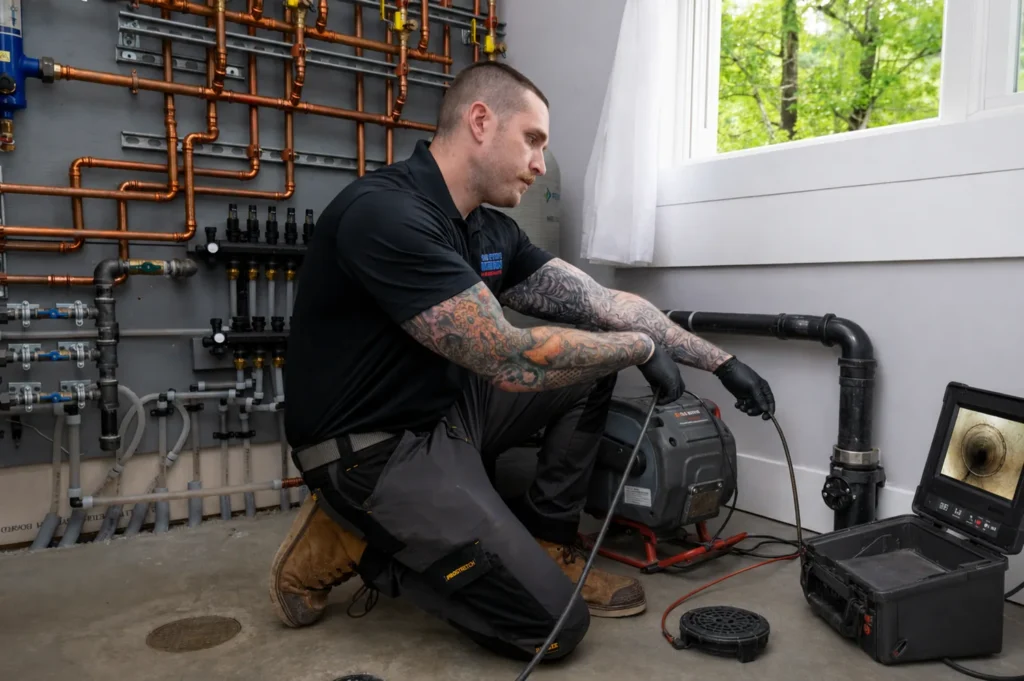
A camera inspection can document visible roots, joint separation, cracks, offsets, deformation, corrosion, standing water, and other conditions along the accessible portion of a line. But heavy roots, sewage, grease, scale, or water can hide the pipe wall. A pre-cleaning video may establish the obstruction while a post-cleaning video is needed to assess the underlying pipe.
The record should identify:
- the access point and direction of travel;
- measured or estimated distance to the finding;
- visible pipe material and diameter where known;
- how much of the line was inspected;
- whether the camera reached the public connection or another known endpoint;
- the exact visibility limits;
- the condition visible after cleaning.
A camera does not by itself provide every measurement needed for depth, grade, or location. Locating and additional site evaluation may be required.
Clearing, monitoring, and repair are different decisions
Clearing removes enough obstruction to restore a usable path. The method must fit the pipe material and condition; aggressive equipment can damage a fragile line. Clearing is not the same as repairing the root-entry point.
Monitoring may be reasonable when flow is restored, the structure remains serviceable, and the owner understands the evidence and recurrence risk. A monitoring plan should name the symptoms that require action and the inspection or maintenance interval recommended for that specific line. Avoid a universal schedule.
Structural repair addresses the defective section or route. Options can include localized excavation, a qualifying trenchless method, or a larger replacement. The choice depends on collapse, offsets, bellies, connections, host-pipe condition, access, utilities, permits, and restoration—not roots alone.
Chemical root-control products are not a substitute for diagnosis. Product compatibility, environmental requirements, label directions, pipe condition, and local wastewater rules all matter. Do not mix drain chemicals or apply a product to a blocked line without understanding where it will go.
Questions to ask after roots are found
- Was the line cleaned enough to see the underlying entry point?
- Can I receive the full before-and-after recording, not only a selected image?
- What pipe material and defect are visible?
- Was the entire accessible line inspected, and what could not be seen?
- Is the recommendation for clearing, monitoring, spot repair, trenchless work, or excavation—and which evidence supports it?
- What recurrence indicators should trigger another inspection?
- What access, utility locating, permits, restoration, and post-repair proof are included?
If the inspection shows recurring roots or structural damage, request sewer-line inspection and repair options tied to the recorded condition rather than purchasing a method by name.
Warning signs that should not wait
Multiple fixtures backing up, wastewater at a lowest-level drain, sewage outside, or a recurring blockage can indicate a main-line restriction. Stop adding water where practical and keep people and pets away from contaminated areas. Do not open a cleanout cap that may be under sewage pressure unless qualified and equipped to control the release.
Safety limits
Wastewater can contain pathogens. Do not enter a sewer, manhole, trench, or confined space. Do not excavate without required utility locating and safe-excavation procedures. Avoid powered drain equipment without training; rotating cables and cutters can injure users and damage piping.
Primary references
Sources used for this guide
Common questions
Questions homeowners ask
Do roots always mean the whole sewer line must be replaced?
No. The repair scope depends on the visible defect, pipe condition, route, access, history, and whether a suitable localized or trenchless repair is possible.
Will cutting roots stop them from returning?
It restores flow but does not necessarily close the entry point. Recurrence risk should be explained from the post-cleaning inspection.
Can the closest tree be identified as the cause from the camera?
Usually not. The camera can show root intrusion and pipe condition, but identifying the plant source generally requires different evidence and may not change the pipe repair decision.