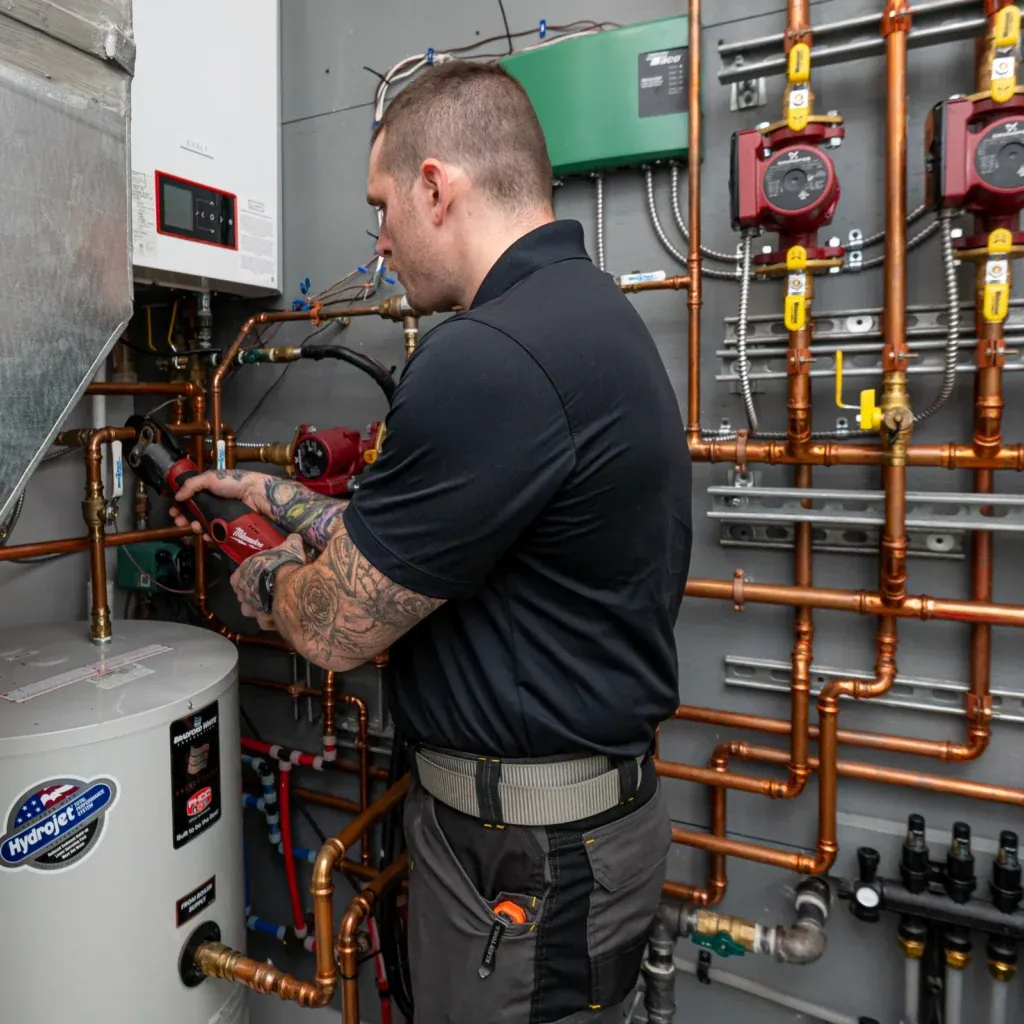
A water heater is one of those things you never think about until the morning it quits — and then it’s all you can think about. The good news is that replacing one isn’t a panic decision if you understand the handful of choices that actually matter. It’s also worth getting right: water heating is typically a home’s second-largest energy expense, accounting for nearly 20% of energy use according to the U.S. Department of Energy. This guide walks through how to pick the right unit for a Capital Region home: tank vs. tankless, gas vs. electric, how to size it to your household, what efficiency numbers really mean, how long these units last, and the early warning signs that yours is on its way out. We’ve been installing and servicing water heaters across the Capital Region since 2006, so this is the same plain-English rundown we’d give a neighbor.
Tank vs. Tankless: Which Style Fits Your Home?
The first fork in the road is whether you want a storage tank water heater or a tankless (on-demand) unit. Both have a real place — it depends on your home and how you use hot water.
A tank water heater keeps a reservoir of water — typically 40 to 75 gallons — heated and ready whenever you need it. They’re the most common choice for good reasons: lower upfront cost, simpler installation, and dependable performance for households with predictable demand. The trade-off is that they reheat that stored water whether you’re home or not, and if a big family drains the tank, you wait for it to recover.
A tankless water heater heats water only as it flows through, so you get a continuous supply and never “run out” the way you can with a tank. They take up far less space, tend to last longer, and waste less standby energy. The trade-offs are a higher upfront cost, the need for adequate gas supply and venting (or electrical capacity), and a flow-rate ceiling — run too many fixtures at once and the temperature can dip. Hard water in some Capital Region areas also means tankless units benefit from periodic descaling to protect the heat exchanger.
- Lean tank if you want lower upfront cost, a straightforward swap, and steady demand.
- Lean tankless if you want endless hot water, longer service life, space savings, and you’re willing to invest more upfront.
Gas vs. Electric: What’s Already in Your Home?
The fuel decision is usually settled by what your home already has. If you have a natural gas line and proper venting, a gas water heater generally recovers (reheats) faster and costs less to run month to month in our climate. If your home is all-electric or doesn’t have a gas connection where the water heater lives, an electric unit is the practical path — simpler venting, no combustion, and a clean install.
For homes outside the natural-gas grid, propane and oil-fired water heating are also part of the picture across our service area, and we work on all of it. If you’re already converting heating equipment, it’s worth asking whether your water heater fuel should change at the same time — sometimes it’s efficient to handle both in one visit. We’ll lay out the options for your specific setup rather than push you toward one fuel. The right answer is the one that fits your home’s existing infrastructure and the way your household actually uses hot water.
Heat Pump Water Heaters: The High-Efficiency Electric Option
If your home runs an electric tank today, a heat pump water heater (sometimes called a hybrid electric) is worth a serious look before a like-for-like swap. Instead of generating heat directly, it moves heat from the surrounding air into the water — with backup electric elements for heavy-demand stretches. That efficiency is real: ENERGY STAR rates certified models at roughly 70% less energy than a standard electric tank, on the order of $550 a year for a family of four, and utility incentives through NYS Clean Heat programs are often available on top — ask us or your utility what’s current.
The Capital Region caveats matter, though, and they’re the part a spec sheet won’t tell you. A heat pump unit needs enough surrounding air to draw from — roughly a 450–700 cubic-foot space per ENERGY STAR guidance — and it works best where that space stays within the unit’s operating temperature range, which is exactly the question to ask about an unheated upstate basement in January. On the plus side, it gently cools and dehumidifies the space around it, which many local basements can use in the summer. The units also run taller than standard tanks, so ceiling clearance is worth measuring before you order.
The practical takeaway: a heat pump water heater is the planned-ahead choice, not the emergency-morning choice. If your electric tank is past its tenth birthday and still limping along, that’s the ideal window to have us look at whether your basement suits one — before the decision gets made for you.
Sizing by Household: Getting the Capacity Right
Undersize a water heater and you’ll fight cold showers; oversize it and you pay to heat water you never use. Sizing comes down to how much hot water your home needs at peak times — think the busiest morning, with showers, the dishwasher, and laundry potentially overlapping.
For a storage tank, the key number alongside gallons is First Hour Rating (FHR) — how much hot water the unit can deliver in a busy hour. As a rough starting point:
- 1–2 people: a 30–40 gallon tank is often enough.
- 2–3 people: 40–50 gallons.
- 3–4 people: 50–60 gallons.
- 5 or more, or a home with high simultaneous demand: 60–80 gallons, or step up to tankless.
For a tankless unit, you size by flow rate in gallons per minute (GPM) and the temperature rise needed — and in our cold New York winters, incoming water is colder, which raises the temperature rise and lowers a given unit’s effective output. That’s exactly the kind of detail that’s easy to miss on a spec sheet, so it’s worth having someone account for it before you buy.
Efficiency: What the Numbers Actually Mean
Efficiency for water heaters is expressed as UEF (Uniform Energy Factor) — the higher the number, the less energy is wasted turning fuel or electricity into hot water. A higher-UEF unit costs more upfront but uses less energy every day it runs, so the gap narrows over the unit’s life.
A few practical points:
- Tankless units generally post higher UEF numbers than standard tanks because they don’t lose energy keeping a reservoir hot.
- Condensing gas models capture extra heat from exhaust for higher efficiency, at a higher price point.
- Efficiency only pays off if the unit is sized and installed correctly — an oversized or poorly vented unit gives back its efficiency advantage.
Don’t chase the highest number for its own sake. The best value is the unit whose efficiency, capacity, and price line up with how your household actually uses hot water.
Lifespan: How Long Should a Water Heater Last?
A conventional tank water heater typically lasts about 8 to 12 years. A tankless unit often runs 15 to 20 years with proper maintenance, which is part of why the higher upfront cost can make sense over time. Real-world lifespan depends heavily on water quality, whether the tank’s sacrificial anode rod is replaced periodically, and whether the unit is flushed to clear sediment. In areas with harder water, mineral buildup shortens that clock, so routine maintenance genuinely pays off here.
Two habits stretch any unit’s life and keep it safe: set the thermostat to 120°F — the setting the Consumer Product Safety Commission recommends to reduce scald risk — and flush the tank about once a year while checking the anode rod. If you’ve never flushed yours, our guide on how often to flush a water heater covers the how and why.
If your unit is past the ten-year mark and showing any of the symptoms below, it’s smart to start planning a replacement on your terms — rather than scrambling the day it fails and floods a finished basement.
Signs It’s Time to Replace
Water heaters rarely die without warning. Watch for these:
- Age over 10–12 years (check the serial number — the date is often encoded in it).
- Rusty or discolored hot water, which points to corrosion inside the tank.
- Water pooling or dampness around the base — a leaking tank can’t be repaired and needs replacing before it lets go.
- Rumbling, popping, or banging sounds from sediment hardening on the tank bottom, which also drags down efficiency.
- Not enough hot water, or it runs out faster than it used to.
- Inconsistent water temperature that swings hot and cold.
- Higher energy bills with no other explanation, as an aging unit works harder to do the same job.
A leaking tank is the one to act on immediately — that’s a flood risk, not a someday project. The rest are signals to start comparing options before you’re forced into a rushed decision.
What We Install
At Empire State Plumbing we install and service quality water heaters from manufacturers we trust to hold up in Capital Region homes, including IBC, Bradford White, and American — across both tank and tankless, and gas, electric, propane, and oil where appropriate. Because we’re a family-run local shop that’s been doing this since 2006, our focus is matching the equipment to your home and your hot-water habits, pulling the right permits, and installing it to code — not steering you toward whatever’s on the truck. Financing is available through Acorn Finance for qualified buyers if you’d like to spread the cost of a replacement.
Making the Decision
Put simply: start with the fuel and venting your home already has, decide whether tank or tankless fits your space and demand, size it to your household’s busiest hour (accounting for our cold incoming water in winter), and pick an efficiency level that matches how you actually use hot water. Get those four right and you’ll have a unit that quietly does its job for a decade or more. If you’d rather talk it through with someone who can look at your actual setup, we’re glad to help — there’s no obligation, and no hard sell.