Heating
Furnace & Boiler Maintenance Checklist Before Winter

By Tom Darling
Owner · City of Albany Master Plumber · Lic. #PLBG21-147
A furnace maintenance checklist for fall has two parts. What you can do yourself: change or clean the filter, clear the space around the furnace or boiler, open the vents, bleed radiators, test the thermostat and check your carbon monoxide detectors. What a professional should do: clean and inspect the burners, check the heat exchanger, test the ignition and safety controls, measure combustion and check the venting. Do the first part in September or early October and book the second before the cold arrives.
Book early: the no-heat calls we logged from 2022 to 2025 bunched up in autumn, with 75 of the 313 in November alone and 182 (58%) between October and December.
When the first hard frost rolls across the Capital Region, you want your heat working the very first time you call for it. A little maintenance now is the difference between a cozy fall and a cold, expensive surprise in January.
Why Fall Is the Right Time to Service Your Heating System
Heating systems run hardest in the dead of winter, and that is the worst time to discover a problem. Servicing your gas furnace or boiler before the cold sets in lets you catch worn parts, clogged components, and safety issues while the weather is still forgiving and parts are easy to get. Many of the homes we serve across Albany, Rensselaer, Saratoga, Schenectady, Columbia, and Greene counties rely on older boilers and historic radiator heat, and those systems especially benefit from a yearly once-over.
A pre-winter tune-up also helps your equipment run more efficiently, which matters when the furnace is cycling day and night through a long Northeast winter. Cleaner, well-adjusted equipment uses less fuel to keep the same rooms warm.
Your DIY Pre-Winter Checklist
There are a handful of simple things any homeowner can handle before the heating season begins:
- Replace or clean the furnace air filter, then plan to check it monthly through the winter.
- Clear at least three feet of space around the furnace or boiler and remove any stored boxes, paint cans, or laundry.
- Make sure supply and return vents are open and not blocked by furniture or rugs.
- For radiator systems, bleed trapped air from each radiator so they heat evenly top to bottom.
- Test your thermostat by switching it to heat and confirming the system fires up and reaches the set temperature.
- Confirm your carbon monoxide detectors have fresh batteries and are working.
If you have a boiler, add these checks
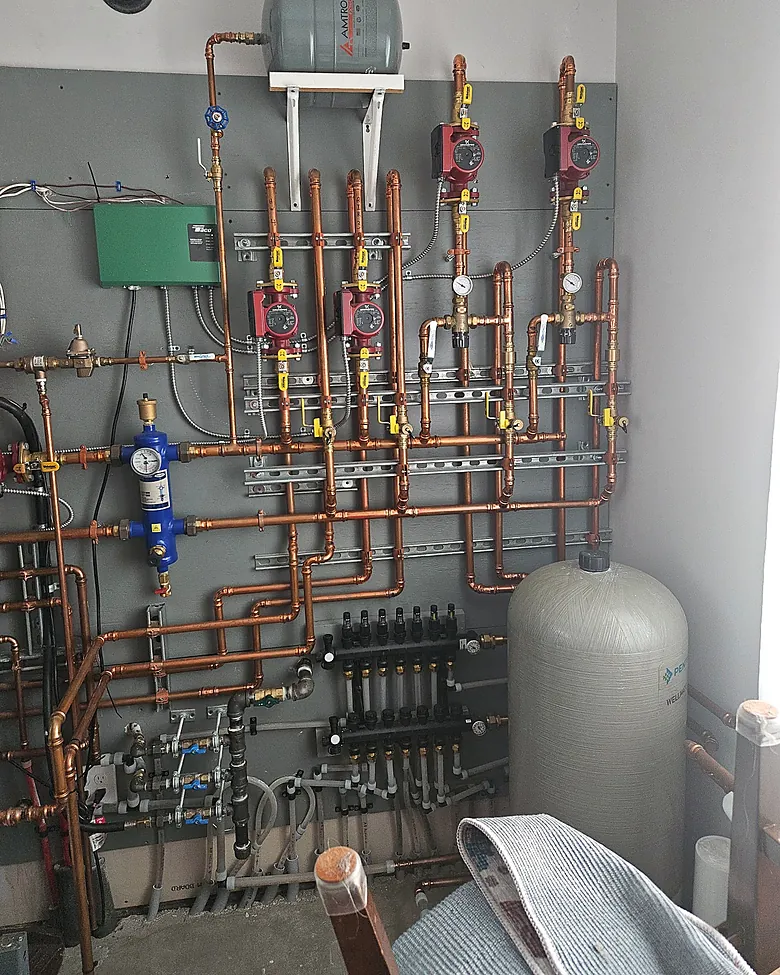
- Look at the pressure gauge. It should sit in the range marked on it or in the manufacturer’s instructions; a gauge that keeps dropping points to a leak or a failing part, so ask for a service call.
- Look around the boiler, its valves and the nearby piping for drips, rust or wet spots.
- Make sure any shutoff valves are in their normal position and that nothing has been stored against the boiler or its vent.
- Listen when it fires. Banging, gurgling or a pump that runs loud are worth mentioning to the technician.
What a Professional Tune-Up Covers
Some checks need trained eyes and the right tools, especially anything involving combustion or fuel. During a professional visit, our technicians inspect and clean the burners, check the heat exchanger for cracks, test the ignition and safety controls, measure combustion to confirm the unit is burning fuel cleanly, and verify proper venting. On boilers we check the circulator, pressure, and low-water cutoff; on oil and propane systems we inspect nozzles, filters, and fuel lines.
A tune-up often finds a worn part or a developing fault, and finding it now is far easier than a no-heat call in a snowstorm. For the full picture of the service, read about furnace and boiler cleaning. If something is already not working, see furnace repair or boiler repair, or our wider heating services for Capital Region homes. Same-day service is offered within business hours when the schedule allows.
Watch for These Early Warning Signs
Even between service visits, your system will usually tell you when something is wrong. Call before a small issue becomes a no-heat emergency if you notice any of these:
- Uneven heat or rooms that never quite warm up.
- Banging, rumbling, or whistling sounds when the system runs.
- A burner flame that is yellow or flickering instead of steady and blue.
- Short cycling, where the system turns on and off rapidly.
- A noticeable jump in fuel use without a change in the weather.
- Any smell of gas, oil, or a persistent musty or burning odor.
Once the system is running, winter HVAC tips cover what to do through the season, and why a furnace blows cold air covers a mid-winter complaint worth knowing.
Stay Ahead With a Maintenance Plan
The easiest way to never miss a fall tune-up is to put it on autopilot. A heating maintenance plan keeps your furnace or boiler on a regular service schedule, so you are not scrambling for an appointment when the first cold snap hits and everyone else is calling too.
To schedule your pre-winter tune-up, call (518) 482-4205 or book online. Family-run since 2006, with local heating help across the Capital Region. Hours: Monday through Friday, 7:30 AM to 6:00 PM.
Questions homeowners ask
Once a year, before the heating season, is the usual recommendation for gas, oil and propane equipment. Early fall is the best time because parts are easy to get and appointments are easier to book than after the first cold snap.
A tune-up cleans and inspects the burners, checks the heat exchanger for cracks, tests the ignition and safety controls, measures combustion to confirm the fuel is burning cleanly and verifies the venting. On boilers it also covers the circulator, the pressure and the low-water cutoff. Our furnace and boiler cleaning guide goes through each step.
A tune-up is priced by the kind of system (furnace, gas boiler or oil boiler) and by what the visit includes, so ask when you call or book online. A maintenance plan keeps the yearly visit from slipping.
Replace or clean the filter, clear at least three feet around the furnace or boiler, open every vent, bleed radiators on a hot-water system, test the thermostat and check carbon monoxide detector batteries. Anything involving combustion, gas, oil or the heat exchanger should be left to a professional.
Call before the cold arrives if the system short cycles, makes banging or whistling sounds, has a yellow or flickering flame on a gas burner, heats unevenly or smells of gas, oil or burning. A gas smell calls for getting everyone outside and phoning your gas utility from a safe distance.
Related services
Call Monday–Friday, 7:30am–6pm, or book online any time.
From the blog
Keep reading
Is an oil-to-gas conversion worth it?
Is an oil-to-gas conversion worth it? When it pays off, when oil or propane still makes sense, what a conversion involves and what to ask before you start.
Keep readingWhy is my furnace blowing cold air?
Furnace blowing cold air? The usual causes (fan setting, clogged filter, ignition or flame sensor), quick checks to try first and when to call a pro.
Keep readingWhy some of your radiators stay cold (and how to fix it)
Radiator not heating? Why one radiator stays cold while others work: trapped air, a stuck valve, sludge or a steam vent, how to bleed it and when to call.
Keep reading
Need a hand from a local pro?
Empire State Plumbing has served Capital Region homeowners since 2006 — licensed (City of Albany #PLBG21-147) and insured. Call Monday–Friday, 7:30am–6pm, or book online any time.
Real homeowners
What Capital Region homeowners say
Verified Google reviews from Capital Region homeowners.