The short answer
What homeowners should know first
Trenchless sewer repair can reduce the amount of open excavation, but it is not automatically the right method for every damaged sewer. Traditional excavation is more disruptive at the surface, yet it can provide the access needed for a collapsed, badly offset, bellied, incorrectly graded, or otherwise unsuitable pipe. The decision begins with diagnosis, not a preference for one tool. A cleaned line, a recorded camera inspection, site access, utility locations, pipe material and geometry, and the required restoration all affect what is technically possible.
First confirm what failed
A sewer camera can show roots, cracks, separated joints, deformation, corrosion, scale, standing water, or an obstruction. It cannot see through heavy sewage, grease, roots, or debris, and a camera image alone may not establish pipe grade or exact depth. Cleaning, locating, measurements, and additional site work may be required before a repair can be designed.
A useful inspection record identifies where the defect is relative to known access points, what pipe material is visible, how much of the line was inspected, and what limited visibility. The conclusion should distinguish a service blockage from a structural failure.
When a trenchless method may fit
“Trenchless” describes a category, not one repair. Depending on the proposed system, a liner may use the existing pipe as a host, while pipe bursting may replace a path by pulling new pipe through it. Each method has its own limits, access requirements, approved materials, connections, diameters, bends, and manufacturer procedures.
A trenchless option may be considered when:
- the existing route and defect can be accurately located;
- the host pipe and geometry meet the selected system's requirements;
- required access pits or cleanouts can be created safely;
- service connections can be addressed correctly;
- utilities, easements, property lines, and structures allow the work;
- the proposed method can correct the actual failure rather than simply cover it;
- inspection, curing or joining, testing, and documentation can be completed as specified.
Even trenchless work may require excavation at entry, exit, transitions, or connections. “No dig” should not be presented as a literal promise unless the approved plan truly requires no excavation.
When excavation may be the clearer option
Open excavation may be required or preferred when the line is collapsed, severely offset, badly deformed, back-pitched, or affected by a belly that the proposed trenchless method cannot correct. It may also be the practical choice when the route must change, a connection must be rebuilt, the host pipe is incompatible, access for trenchless equipment is worse than access to the defect, or surface restoration is limited and manageable.
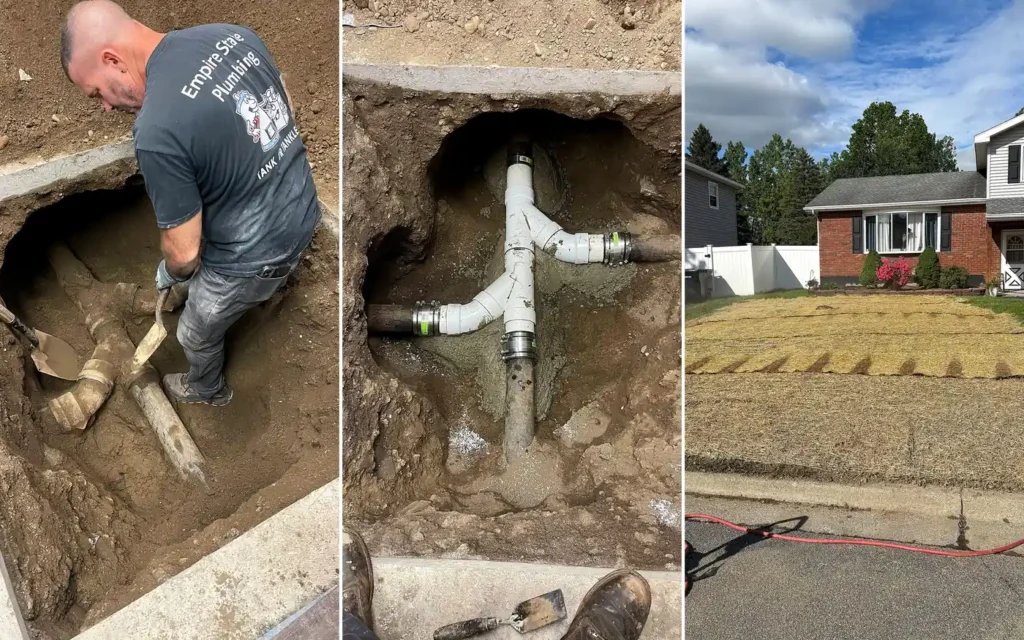
Excavation also lets the installer see bedding, grade, fittings, and surrounding conditions directly. That access comes with a larger surface impact and requires a clear plan for soil, pavement, landscaping, structures, utilities, and final restoration.
Six questions that decide the method
- What does the recorded inspection show after adequate cleaning? Ask for the full context, not one selected still.
- Can the chosen method correct the defect? Clearing roots is not structural repair; lining a pipe does not necessarily correct a belly or bad grade.
- What access is required? Map cleanouts, pits, equipment staging, traffic, interior access, and property boundaries.
- What is near the route? Before excavation, New York projects require the appropriate utility-location process. Private utilities may require separate locating.
- What approvals apply? Permits, municipal or utility requirements, easements, and connection standards vary by jurisdiction and project.
- How will completion be proven? Specify materials, installation standard, connection work, testing, post-work video, restoration, exclusions, and written warranty terms.
Compare total scope, not just the repair label
Two proposals may use the same headline method but include different access, bypass, cleanup, connections, paving, landscaping, testing, and warranty terms. The comparison should use the same defect location and intended outcome. It should state who handles permits, utility coordination, private locating, restoration, and unexpected conditions.
For a method-neutral assessment, request sewer-line repair diagnosis and options based on a documented inspection and the actual site.
Safety limits
Do not enter a sewer, trench, manhole, or confined space. Never excavate before the required utility-location process and a site-specific safety plan. Sewer gas, contaminated wastewater, unstable soil, buried utilities, traffic, and powered equipment can create serious hazards. A surface mark does not locate every private line or eliminate the need for safe excavation practices.
Primary references
Sources used for this guide
Common questions
Questions homeowners ask
Is trenchless repair always less expensive?
No. Cost depends on diagnosis, access, length, depth, material, connections, site constraints, restoration, and the selected system. Compare complete written scopes.
Can roots simply be cleared permanently?
Clearing can restore flow, but roots usually enter through an available defect or joint. Recurrence depends on the pipe's condition and the long-term plan.
Does a camera inspection guarantee the line's condition?
No. Visibility, cleaning, water, bends, access, and equipment limit what the camera can establish. The report should state those limits.