The short answer
What homeowners should know first
An air conditioner should be repaired when the diagnosed problem is safely repairable and the repair makes sense in the context of the whole system. Replacement becomes a stronger option when safety, repeated failures, refrigerant or major-component scope, poor sizing, damaged distribution, comfort problems, or the complete cost and risk of continued ownership outweigh a defensible repair. Age is only one input. A decision should begin with measurements and a written diagnosis, not a rule that every system over a certain age must go.
First separate the symptom from the failure
“Not cooling” can involve the thermostat, electrical supply, controls, indoor airflow, filter, blower, evaporator coil, condensate safety, refrigerant circuit, outdoor coil, fan, compressor, ductwork, or a combination of conditions. Ice on a line or coil does not by itself prove the system is low on refrigerant, and adding refrigerant without diagnosing a leak is not a complete repair strategy.
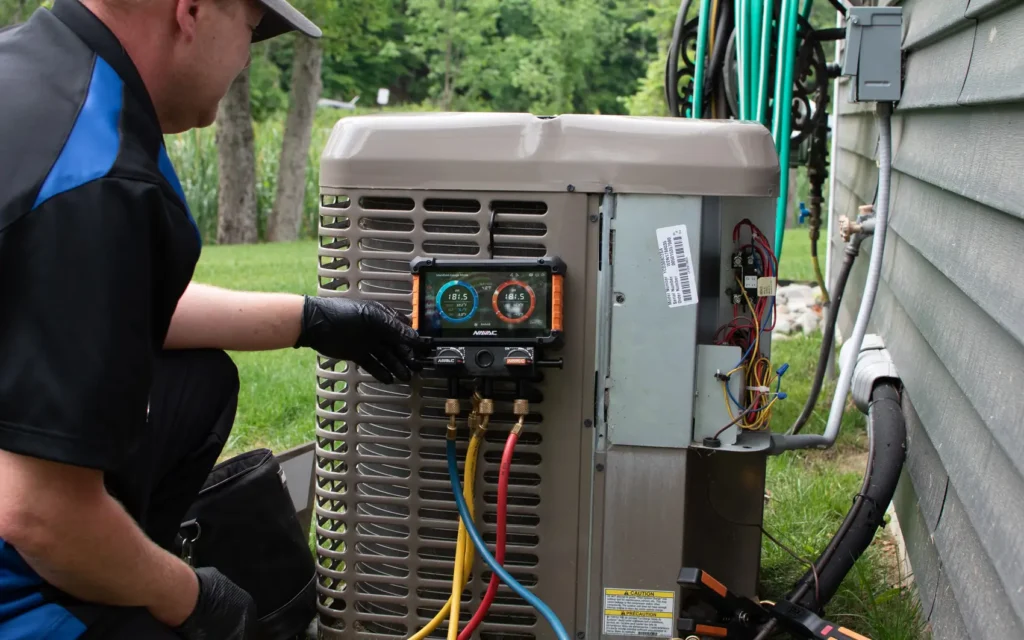
A useful diagnosis records relevant temperatures, airflow or static-pressure evidence where needed, electrical readings, refrigerant findings when applicable, fault codes, coil and filter condition, condensate operation, and the technician's conclusion. The exact test set depends on the system and complaint.
The repair case
Repair may be reasonable when:
- the failure is isolated and the underlying cause can be corrected;
- the system can return to safe, manufacturer-consistent operation;
- required parts and refrigerant are available for the exact equipment;
- the repair does not leave a known major problem unaddressed;
- comfort and humidity performance were otherwise acceptable;
- the owner understands the written scope, warranty, and remaining uncertainty.
Maintenance and minor repairs should not be misrepresented as restoration of a damaged compressor, leaking coil, unsafe wiring, or failing system. Conversely, a serviceable capacitor, control, drain, or airflow issue does not automatically justify replacement.
The replacement case
Replacement deserves a full comparison when the system has a nonrepairable or uneconomical major failure, repeated breakdowns, significant refrigerant leakage, widespread coil damage, unsafe electrical conditions, severe capacity mismatch, persistent comfort or humidity problems, or a project scope that approaches a complete system solution.
Refrigerant type matters, but it is not a stand-alone verdict. The proposal should state what refrigerant the equipment uses, what the diagnosis found, what components are compatible, and whether a repair can be performed in accordance with current requirements and manufacturer guidance.
Eight factors to compare on the same page
- Verified diagnosis: failed component, cause, and evidence.
- Safety and compliance: electrical, refrigerant, condensate, disconnect, overcurrent protection, and installation conditions.
- Repair history: actual dates and work, not an impression that it has “needed a lot.”
- Parts and support: availability, compatibility, lead time, and written warranty.
- Load and sizing: a replacement should use a documented cooling-load method rather than copying the old tonnage.
- Ducts and airflow: leakage, restrictions, return capacity, balancing, insulation, and zone conditions can limit either option.
- Comfort goals: temperature, humidity, noise, zoning, and rooms that are consistently difficult.
- Complete scope: indoor and outdoor equipment, controls, electrical, drain, line set, duct changes, permits, startup, commissioning, disposal, and exclusions.
Why sizing and ducts matter before replacement
Oversized equipment can cycle in ways that affect comfort and moisture control. Undersized equipment may not meet the documented design load. But equipment capacity cannot be judged from runtime during one unusually hot afternoon alone.
The replacement design should account for the building and distribution system. If additions, windows, insulation, air sealing, occupancy, or ductwork have changed, the old nameplate is not a load calculation. A high-efficiency unit connected to poor airflow or leaky ducts may not deliver the expected result.
Compare ownership outcomes, not a single headline number
Ask for repair and replacement scopes that name inclusions, exclusions, warranties, maintenance, and foreseeable related work. If an efficiency or incentive claim affects the decision, verify the exact model, rating, eligibility, program status, and homeowner conditions at the time of the proposal.
Start with professional AC diagnosis and repair so the repair option is supported by evidence. If replacement is recommended, the same evidence should carry forward into the load, equipment, duct, electrical, and commissioning plan.
Safety limits
Air-conditioning equipment contains line voltage, capacitors, moving parts, pressurized refrigerant, and condensate that can damage the building. Do not bypass a safety, repeatedly reset a breaker, open the refrigerant circuit, or handle a swollen or damaged capacitor. If there is smoke, burning odor, sparking, or wet electrical equipment, keep clear and follow emergency and utility guidance as appropriate.
Primary references
Sources used for this guide
Common questions
Questions homeowners ask
Does one refrigerant leak mean the system must be replaced?
Not automatically. The leak location, repairability, component condition, refrigerant, parts, and full system context determine the options. A recharge without leak diagnosis is not a complete long-term comparison.
Is a larger replacement better?
No. Capacity should match the documented load and distribution. Larger equipment can create cycling, comfort, noise, and humidity problems.
Can a new outdoor unit be matched to the old indoor unit?
Only when the combination is approved and meets the project's requirements. Ask for the exact matched-system documentation, controls, refrigerant, metering device, and rated performance.