The short answer
What homeowners should know first
A water softener and a whole-house water filter solve different problems. A conventional ion-exchange softener primarily addresses hardness minerals such as calcium and magnesium. A filter is selected to reduce specific particles, tastes, odors, chemicals, metals, or other constituents—but only when its media, capacity, and certification match the verified target. Some homes need one, some need both, and some need neither. The right decision starts with the water source, a clearly defined complaint, and appropriate testing—not the equipment name.
What a water softener does
Hard water can contribute to scale on fixtures and equipment, spotting, and increased soap use. An ion-exchange softener trades hardness ions for other ions as water passes through resin. The system periodically regenerates, which requires salt or another approved regenerant, water, a drain connection, power for many controls, and maintenance.
Softening does not make every contaminant disappear. It should not be sold as a universal purification or health system. Sodium or potassium contribution, discharge, septic or sewer considerations, flow capacity, bypass arrangement, and the effect on connected equipment belong in the design discussion.
What a whole-house filter does
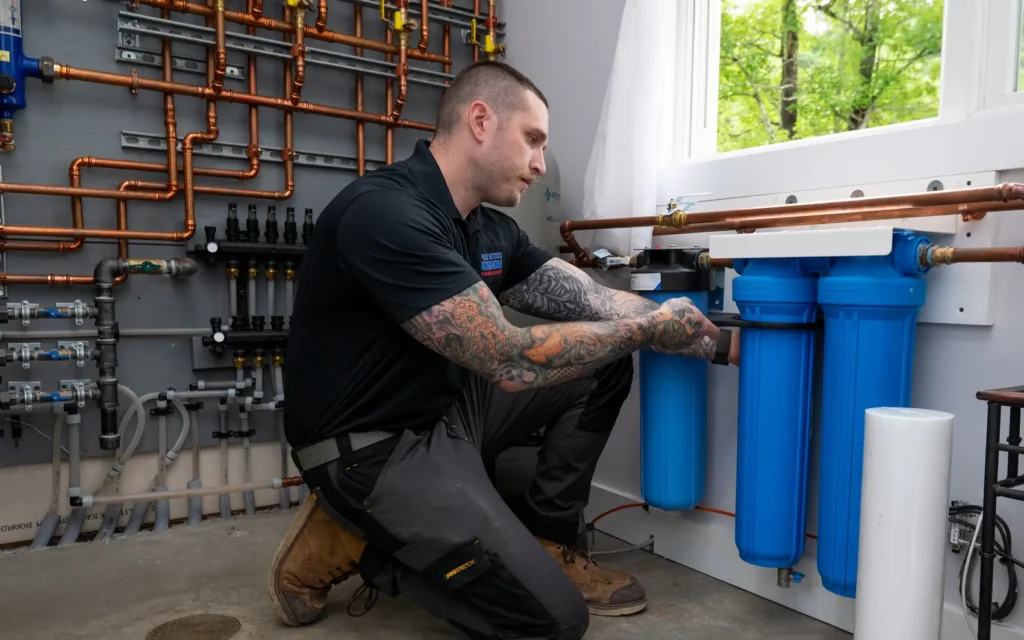
“Whole-house filter” can mean a sediment cartridge, activated-carbon system, oxidation/filtration equipment, or another treatment train. Each works differently. A sediment filter does not necessarily reduce dissolved chemicals. Carbon selected for taste and odor does not automatically remove hardness. A device's advertising category is less important than its verified performance for the specific constituent, concentration, flow, and service life.
Look for a performance claim or certification that names the reduction being promised and the conditions under which it applies. The maintenance schedule and replacement media are part of performance; an exhausted or poorly maintained filter may not deliver the intended result.
Public water and private wells require different context
Customers on a public water system can review the supplier's current water-quality report, but conditions at a particular building may also involve premise plumbing. A private well owner is responsible for the well's testing and treatment decisions and may need laboratory analysis based on local guidance and site conditions.
Visible color, odor, taste, staining, scale, or skin feel can guide questions, but none identifies every constituent. A test should be appropriate for the suspected issue. A simple hardness strip, for example, is not evidence about microorganisms, arsenic, lead, or many other contaminants.
A decision framework that avoids guesswork
- Identify the source. Public supply, private well, hauled water, or another source changes the available records and responsibilities.
- Define the exact goal. Scale reduction, sediment, chlorine taste, iron staining, odor, or a laboratory-detected constituent are different targets.
- Collect valid evidence. Use the supplier report and/or an appropriate certified laboratory or accepted test method. Document sample location and timing.
- Match treatment to the result. Confirm the equipment's tested performance, required flow, capacity, contact time, pretreatment, and operating limits.
- Design the installation. Include pressure, peak flow, bypass, drainage, backwash or regeneration, electrical supply, space, freeze protection, and protection of drinking-water plumbing.
- Plan maintenance and verification. State the salt, cartridge, media, cleaning, sanitizing, and retesting responsibilities. Include what happens if a result changes.
When both systems may be proposed
A home may have hardness plus another verified treatment target. In that case, equipment order and sizing matter. Sediment, iron, chlorine, hardness, pH, or other conditions can affect downstream media and appliances. The treatment train should be designed as one system rather than assembled from unrelated products.
Request a water-treatment system assessment that starts with the water source, test evidence, and defined goal. Ask for the model-specific performance basis and continuing maintenance in writing.
Safety and health limits
Do not use a sales demonstration, taste test, or visual sample as proof that water is safe. Do not make medical claims from a home treatment device. If a public health authority issues a boil-water, do-not-drink, or other advisory, follow that authority's instructions; a household filter or softener should not be assumed to override it.
Private-well disinfection and treatment for microorganisms require source control, proper testing, and current health guidance. Incorrect plumbing can also create cross-connections or contamination risks.
Primary references
Sources used for this guide
Common questions
Questions homeowners ask
Does a softener filter drinking water?
It treats hardness through ion exchange; that is not the same as broad contaminant filtration. The answer for any other constituent depends on verified equipment performance.
Will a whole-house filter stop scale?
Not necessarily. Many filters target particles, taste, odor, or specific constituents rather than dissolved hardness. Confirm the technology and tested claim.
Can I choose a system from a water report alone?
A report is valuable, but equipment selection also depends on the building's plumbing, flow, pressure, water use, sample location, and any change between the source and the tap.